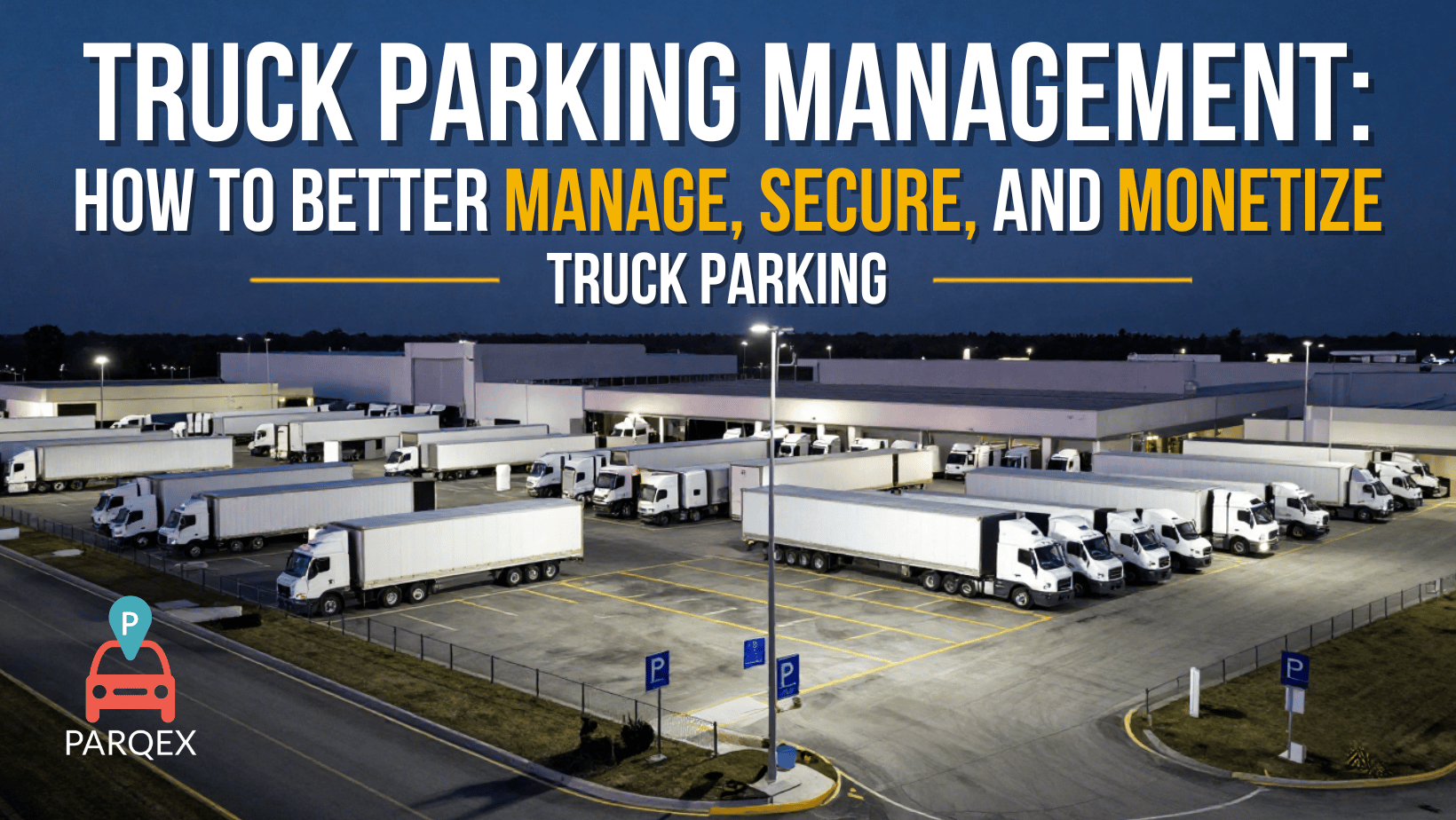



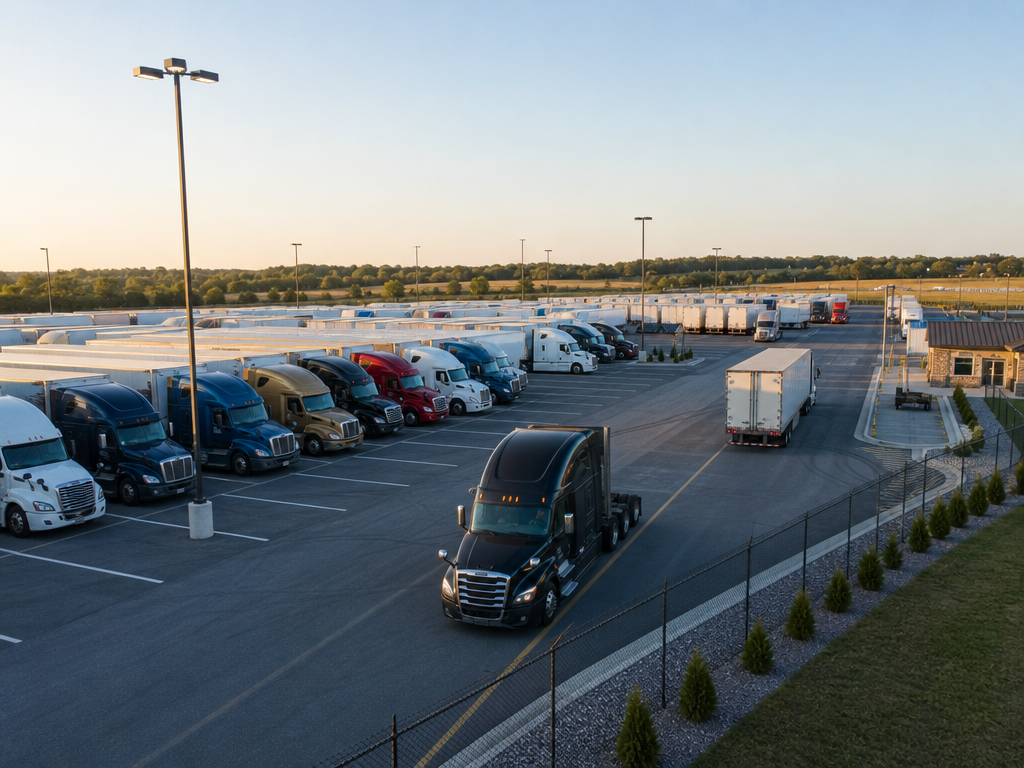
Managing truck parking involves much more than keeping track of which spaces are occupied.
Drivers need to find parking. Reservations need to be managed. Vehicles need to be identified. Payments need to be processed. Access needs to be controlled. Parking rules need to be enforced. And operators need some way to understand what’s actually happening across their property.
When those functions are handled separately or manually, the parking operation becomes harder to manage as it grows.
Truck parking management software provides the technology layer that connects them.
Rather than relying on disconnected spreadsheets, payment systems, phone calls, paper records, or manual vehicle checks, operators can use software to manage parking operations from a single, coordinated system.
For truck stops, logistics facilities, fleets, municipalities, and commercial property owners, this can mean greater visibility into parking operations and better control over valuable parking inventory.
What Is Truck Parking Management Software?
Truck parking management software is a technology used to manage the day-to-day operation of commercial truck parking.
It can connect drivers, vehicles, parking spaces, reservations, payments, access permissions, enforcement, and parking data within a single system.
The software is one component of the broader truck parking management system.
Management describes the overall operational strategy: how parking inventory is allocated, controlled, monitored, and optimized. Software provides the digital infrastructure that makes many of those processes easier to execute at scale.
Depending on the property and platform, truck parking management software can help operators:
- Publish available parking inventory
- Accept advance reservations
- Register drivers and vehicles
- Process parking payments
- Control access
- Verify license plates
- Monitor parking sessions
- Identify potential violations
- Support enforcement teams
- Track occupancy and utilization
- Measure parking revenue
- Manage multiple parking locations
The objective isn’t simply to digitize a parking lot. It’s to give operators a clearer picture of what’s happening—and tools to act on that information.
Why Truck Parking Operations Need Software
Truck parking facilities are active environments.
Vehicles arrive and depart throughout the day. Some drivers make reservations ahead of time,, while others may arrive without reservations. Different areas may have different parking rules. Some vehicles may be authorized for recurring access, while others are permitted for a single session.
And every occupied space represents inventory.
Managing that activity manually becomes increasingly difficult as volume grows.
Consider something as simple as determining whether a truck belongs in a particular space.
An employee may need to determine:
- Who the vehicle belongs to
- Whether the driver has a reservation
- Whether payment was completed
- When the parking session began
- When the truck is supposed to leave
- Whether the vehicle is parked in the correct area
- Whether an exception or special permission exists
Without connected information, answering those questions may require checking multiple systems or simply asking the driver.
Software gives operators a shared source of parking information.
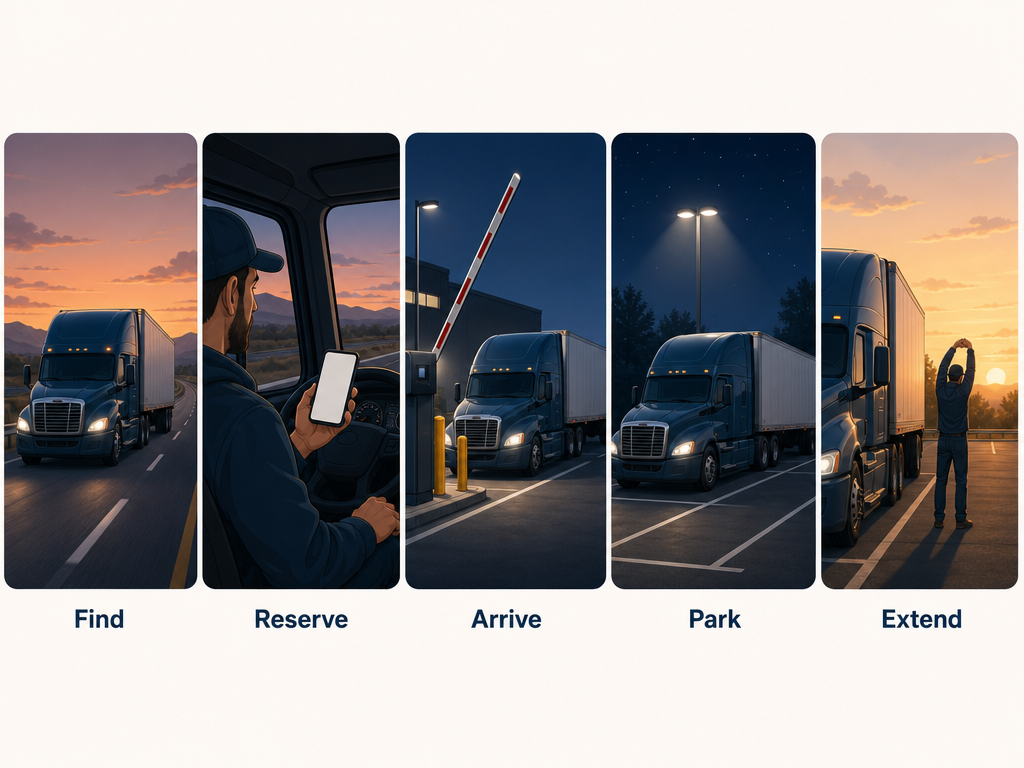
1. Digital Truck Parking Reservations
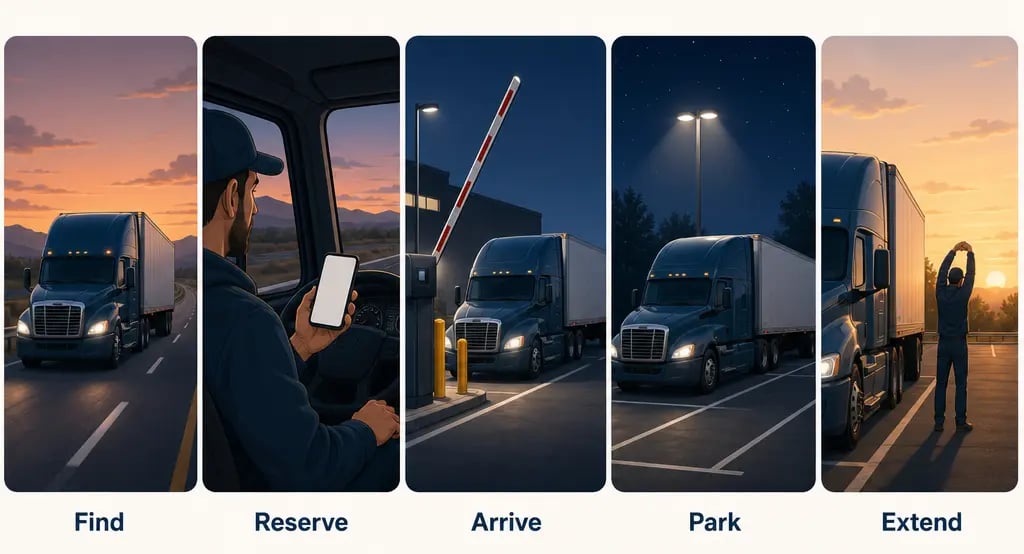
Reservations are one of the most important components of truck parking technology.
For drivers, the ability to reserve parking in advance can provide greater certainty that a legal place to stop will be available when they arrive.
For operators, reservations transform future demand into usable information.
A reservation can tell the property:
- Which vehicle is expected
- When it should arrive
- How long it plans to stay
- Which parking inventory has been allocated
- Whether the parking session has been paid for
Instead of only learning that the lot is full when the final space is occupied, operators gain visibility into expected demand before vehicles arrive.
ParqEx has already used this model through its Truck Parking Marketplace, connecting commercial drivers searching for parking with available inventory.
Reservations become even more valuable when they’re connected with the rest of the parking operation rather than functioning as a standalone booking tool.
2. Driver and Vehicle Management
A reservation represents more than a space. It represents a person and a vehicle that should be allowed to use that space for a specific period.
Truck parking management software can maintain digital records that link drivers and vehicles to their parking permissions.
That can help operators distinguish among:
- One-time customers
- Recurring drivers
- Fleet vehicles
- Employees
- Vendors
- Delivery vehicles
- Visitors
- Unauthorized vehicles
For properties managing multiple types of commercial traffic, those distinctions matter.
A distribution facility, for example, may simultaneously have trucks making scheduled deliveries, fleet vehicles stored on-site, drivers waiting for appointments, and commercial vehicles using designated paid parking.
Software helps keep those activities organized without treating every truck on the property the same way.
3. Digital Payments
Parking revenue becomes much harder to manage when payment is separated from the parking session itself.
Digital payment capabilities can connect the transaction directly with the reservation, vehicle, parking duration, and space. That creates a clearer record for both drivers and operators.
Depending on the parking model, properties may offer:
- Hourly parking
- Overnight parking
- Daily parking
- Recurring parking
- Reserved premium spaces
- Fleet arrangements
Software can also reduce the administrative work involved in manually collecting and reconciling payments.
And for properties making previously unused parking available to commercial drivers, payments are what transform that capacity into an actual revenue stream.
As we’ve discussed in Parking Space Revenue, underused parking can become a productive asset when owners have a reliable way to control access, collect payment, and manage how the inventory is used.
4. Access Control
Accepting a reservation is only one part of managing parking. Operators also need to ensure that the people entering the property are actually permitted to be there.
Access control can connect parking permissions with gates, credentials, vehicle information, schedules, or other entry methods.
Instead of treating the entire lot as either open or closed, properties can create more specific rules.
For example, a truck parking area could be available:
- Only to drivers with active reservations
- During designated overnight hours
- To specific fleets
- To approved recurring users
- In particular sections of the property
- For a defined length of time
This is especially important when truck parking exists alongside another primary property use.
A commercial property offering unused overnight parking may want trucks to arrive only after normal business operations end and depart before employees or customers return.
Software makes those rules easier to define and consistently apply.
5. License Plate Recognition
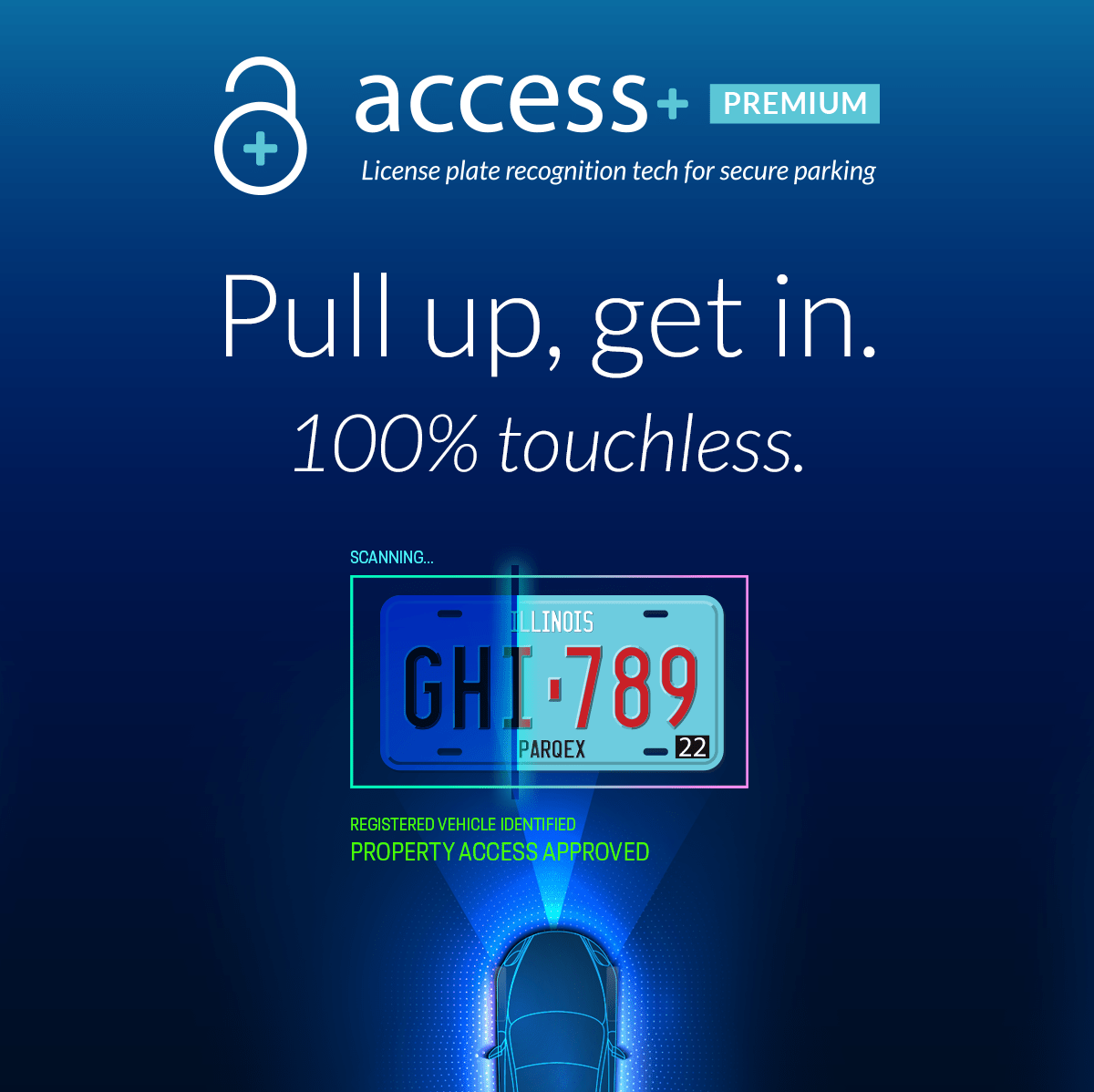
License plate recognition adds another layer of automation. Rather than relying exclusively on permits, stickers, or manual vehicle checks, LPR can identify a truck through its license plate.
When the plate is connected with parking management software, that identification becomes actionable. The system can associate the vehicle with an active reservation, an approved parking session, an access permission, or a payment record.
Mobile LPR can also help parking and security personnel verify vehicles as they patrol large facilities.
ParqEx has explored how mobile LPR improves operational efficiency and security by giving personnel faster access to vehicle information.
In a large truck parking facility, reducing repetitive manual checks can make a meaningful difference in operations.
6. Parking Enforcement
Truck parking software shouldn’t stop working once the vehicle enters the property. Operators still need to know when parking rules aren’t being followed.
Potential violations can include:
- No valid reservation
- Unpaid parking
- Expired parking sessions
- Overstays
- Parking in unauthorized areas
- Occupying reserved inventory
- Violating property-specific parking rules
The problem with purely manual enforcement is that personnel may see the vehicle but lack the information necessary to determine its status.
Connected software can give enforcement or security teams additional context.
Before taking action, personnel can determine whether the truck has a valid parking session and whether a violation has actually occurred. That can support more consistent enforcement while reducing unnecessary confrontations with legitimate users.
Our truck parking enforcement article explores this challenge in greater detail.
7. Occupancy and Utilization Analytics
Knowing that a parking lot is busy isn’t enough. Operators need to understand how the inventory performs over time.
Truck parking management software can provide data on questions such as:
- When does the facility reach peak occupancy?
- Which days experience the most demand?
- How long do trucks typically remain parked?
- Which spaces or areas are most frequently used?
- How often do reservations go unused?
- How frequently do overstays occur?
- Which locations consistently reach capacity?
- How much revenue does the parking operation generate?
Those insights can influence decisions about pricing, staffing, enforcement, availability, and future expansion. They can also reveal an important distinction:
A parking capacity problem and a parking utilization problem are not always the same thing.
Before investing in additional physical inventory, operators should understand how efficiently their existing spaces are being used.
Truck Parking Software Can Help Unlock Underused Inventory
The truck parking shortage creates an interesting mismatch.
Drivers need safer places to park. At the same time, some privately owned parking inventory sits empty during predictable periods. Technology can help bridge that gap.
A commercial or industrial property may not want unrestricted truck access to its parking lot. But it may be more comfortable to offer 30 designated spaces between 7 p.m. and 6 a.m.
Truck parking management software can help establish those boundaries.
The property can define:
- How many spaces are available
- When they’re available
- Who can reserve them
- What parking costs
- How long vehicles can remain
- Where trucks may park
- How access is verified
- How violations are handled
That turns the proposition from “open your parking lot to trucks” into something much more controlled: Make specific parking inventory available under specific rules.
That’s a fundamentally different operating model and one that could help bring more existing parking capacity into the market.
Managing Multiple Truck Parking Locations
Software becomes even more important when an operator manages multiple facilities. Without a centralized platform, each property can become its own island.
One location may use different payment processes. Another may track vehicles differently. A third may have its own enforcement workflow. Management then lacks a consistent view across the portfolio.
Centralized truck parking software can help operators compare:
- Occupancy by location
- Revenue by facility
- Reservation activity
- Violation patterns
- Utilization trends
- Driver activity
- Parking availability
That becomes useful not only for day-to-day operations but also for strategic decisions. If one facility regularly reaches capacity while another nearby property remains underutilized, the operator has information it can act on.
What Should Operators Look for in Truck Parking Management Software?
Not every parking operation needs exactly the same technology.
A property evaluating truck parking solutions should start with the operational problems it actually needs to solve rather than choosing software based solely on the longest feature list.
Some important questions include:
Can drivers reserve parking in advance?
If reservations are important to the operation, they should be connected to availability and vehicle information rather than exist in isolation.
Can the system identify who is authorized to park?
Operators should be able to quickly distinguish legitimate users from unauthorized vehicles.
Can parking permissions change based on time or user?
This is particularly important for shared or mixed-use properties.
Can payments be linked directly to parking sessions?
Operators should be able to understand what was paid, by whom, and for which parking activity.
Can the platform work with LPR?
Vehicle recognition can reduce the need for manual verification and support access and enforcement workflows.
Does it support enforcement?
Software should help personnel understand whether a vehicle is actually violating parking rules.
Does it provide useful operational data?
Reporting should help management understand utilization, occupancy, revenue, and recurring problems, not simply produce data for its own sake.
Can it scale across multiple properties?
Operators managing portfolios should consider whether they can maintain consistent processes without running separate systems at every location.
Software Doesn’t Replace Parking Operations. It Connects Them.
Technology alone doesn’t solve truck parking. Properties still need clear parking policies. Drivers still need appropriate spaces. Personnel may still need to respond to violations. Operators still need to make decisions about pricing, capacity, and property use.
The value of truck parking management software is that it connects those decisions with what’s actually happening in the parking lot.
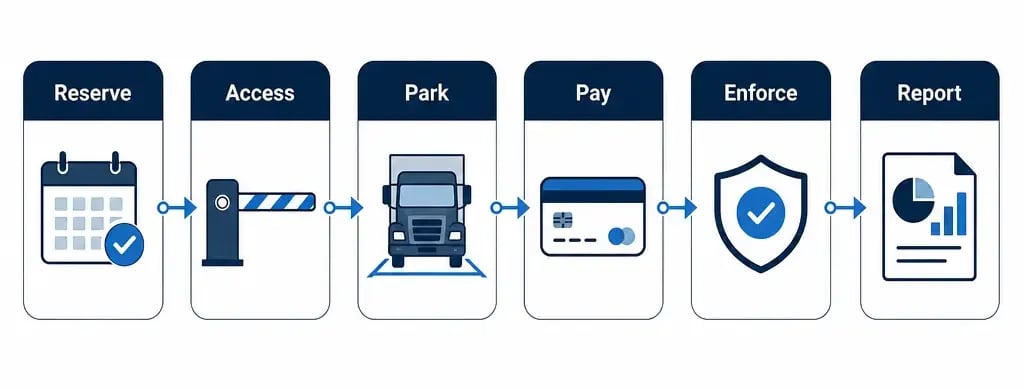
- A reservation tells the system who should arrive.
- Vehicle information identifies what they’re driving.
- Access permissions determine whether they can enter.
- Payment establishes the transaction.
- LPR can assist with verification.
- Enforcement manages exceptions.
- Analytics show what happened across the operation.
Instead of separate activities, they become part of a single parking lifecycle.
From Parking Software to a Better Parking Operation
Truck parking management software isn’t valuable simply because it digitizes a parking operation.
It’s valuable when that technology makes the operation easier to manage.
- Drivers gain greater visibility into where they can park.
- Operators gain better information about who is using their property.
- Reservations make demand more predictable.
- Digital payments simplify transactions.
- Access controls establish boundaries.
- LPR helps verify vehicles.
- Enforcement becomes more informed.
- Analytics reveal how parking inventory actually performs.
Together, those capabilities can help properties get more from the spaces they already have.
ParqEx provides a connected truck parking platform designed to help operators manage parking availability, reservations, access, payments, vehicle activity, enforcement, and parking data.
For operators looking to improve existing truck parking or make appropriate unused parking inventory available to commercial drivers, the goal isn’t simply more technology. It’s a better-managed parking operation.