





Guest Parking Is Not a Small Problem
Most properties treat guest parking like a minor detail. A few spaces get set aside. Maybe there are a couple of loose rules. Beyond that, it doesn’t get much attention.
But when those spaces are always full, it quickly turns into one of the biggest pain points on a property.
Residents cannot host visitors without stress. Guests are not sure where to park. And management ends up dealing with the same complaints over and over.
At that point, guest parking is no longer a side issue. It becomes a core operational problem. If your guest parking is always full, it is usually a sign of a deeper issue with how parking is being managed.
Why Guest Parking Fills Up So Fast
When guest parking is always full, it usually is not just a supply issue.
More often, it comes down to how those spaces are being used.
You will typically see a mix of:
- Residents using guest parking long-term
- Guests staying longer than they are supposed to
- No system to track who is parked where
- Inconsistent or nonexistent enforcement
- Poor overall allocation of spaces
Individually, these might not seem like major problems. But together, they quickly overwhelm the system.
The Hidden Impact of Full Guest Parking
When guest parking is consistently full, the effects show up everywhere.
You start to see:
- More parking complaints from residents
- Tension between neighbors
- Guests parking in the wrong areas
- An increase in violations and enforcement issues
- A breakdown in overall parking compliance
In a lot of properties, this is where larger parking problems begin.
Step 1: Identify Who Is Actually Using Guest Parking
Before you try to fix anything, you need to understand what is really happening.
Take a step back and look at patterns:
- Are the same vehicles always in guest spaces?
- Are residents relying on guest parking regularly?
- Are guests overstaying without consequences?
Without that visibility, you are guessing.
This is where parking analytics and reporting can make a big difference, because it gives you a clear picture of how spaces are actually being used.
Step 2: Set Clear Rules for Guest Parking
Guest parking needs structure. Without it, people will fill in the gaps however they want.
A strong parking policy should clearly define:
- Who qualifies as a guest
- How long guests can park
- Where guest parking is allowed
- What happens if rules are broken
If expectations are unclear, misuse becomes the default.
Step 3: Implement a Guest Registration System
One of the biggest gaps in most properties is the lack of a simple way to track guest vehicles.
Without a system, it is almost impossible to know who belongs and who does not.
A structured approach should include:
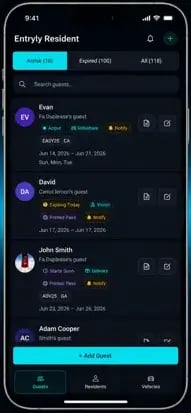
- Digital guest registration
- Time-based access
- Clear expiration limits
It does not need to be complicated. It just needs to exist.
Step 4: Enforce Guest Parking Consistently
Even the best rules will not matter if they are not enforced.
When enforcement is inconsistent, people notice quickly.
- Residents start using guest spaces as overflow
- Guests stay longer than allowed
- Turnover slows down
Over time, the system stops working entirely.
Consistent enforcement, especially when tied to unauthorized parking policies, is what brings things back under control.
Step 5: Reevaluate How Guest Parking Is Allocated
Sometimes the issue is not misuse. It is how spaces are set up.
It is worth asking:
- Are there enough guest spaces for actual demand?
- Are they located where people need them?
- Are other spaces sitting empty while guest parking stays full?
In some cases, small adjustments can relieve a lot of pressure.
This is where mixed-use parking solutions can help rebalance how spaces are used across different groups.
Step 6: Consider Overflow and Off-Site Options
If demand consistently exceeds supply, it may be time to expand your options.
That does not always mean building more parking.
You might look at:
- Temporary overflow areas
- Agreements with nearby lots or garages
- Shared parking during certain times of day
Using approaches like parking aggregation, properties can extend capacity without major changes.
How Technology Helps Fix Guest Parking Issues
Managing guest parking manually can get messy, especially as properties grow.
With the right tools in place, you can:
- Track guest vehicles in real time
- Automate registration and expiration
- Enforce rules consistently
- Reduce the amount of manual oversight
These capabilities are part of broader smart parking solutions that make the system easier to manage day to day.
Solutions like ParqEx help bring everything into one place so you are not constantly reacting to issues.
The Shift from “Always Full” to “Properly Managed”
The goal is not to eliminate demand. People are always going to have guests.
The goal is to manage that demand in a way that makes sense.
Instead of asking:
“How do we add more guest parking?”
It is usually more helpful to ask:
“How do we make sure these spaces are being used the way they were intended?”
That shift is what changes the outcome.
Final Takeaway
If your guest parking is always full, it is usually not just about having too few spaces.
It is a mix of unclear rules, inconsistent enforcement, and limited visibility.
Once those pieces are addressed, things start to stabilize.
Availability improves. Turnover increases. And the issue that felt constant becomes something you can actually manage.
Frequently Asked Questions
Start by understanding who is using the spaces, then set clear rules, enforce them consistently, and introduce a simple registration system.
Start by understanding who is using the spaces, then set clear rules, enforce them consistently, and introduce a simple registration system.
Clear policies, simple tracking systems, and consistent enforcement are the foundation.
In some cases, yes. Shared models can work well when demand changes throughout the day.
The key is consistency. Clear rules, visible enforcement, and a way to track usage go a long way.