



Truck parking enforcement is sometimes treated as the final step in a parking operation. A vehicle violates the rules. Someone notices. Enforcement responds.
But effective truck parking enforcement should begin much earlier than that.
Operators need to know which vehicles are authorized, when they’re permitted to park, where they’re allowed to park, and when that permission expires. Enforcement personnel then need reliable information to distinguish an actual violation from a legitimate parking session.
That becomes especially important when truck parking is reservable and paid.
An unauthorized truck occupying a space isn’t simply breaking a parking rule. It may be occupying inventory another driver has already reserved and paid to use.
Modern truck parking enforcement therefore isn’t just about removing vehicles.
It’s about protecting parking availability, maintaining an orderly property, supporting legitimate drivers, and making sure valuable truck parking inventory remains available to the people authorized to use it.
What Is Truck Parking Enforcement?
Truck parking enforcement is the process of verifying that commercial vehicles are following the rules established for a parking property and responding when they aren’t.
Depending on the facility, violations may include:
- Parking without authorization
- Parking without payment
- Remaining after a reservation expires
- Occupying the wrong space or parking area
- Blocking entrances, drive aisles, or operational areas
- Parking in spaces reserved for other users
- Violating property-specific parking restrictions
Historically, determining whether a truck was authorized could require paper permits, windshield tags, handwritten records, spreadsheets, or direct communication with property staff.
Digital truck parking management changes that process.
Reservations, vehicle records, payments, access permissions, and parking sessions can establish a digital record of who is supposed to be on the property. Enforcement can then begin with verification.

Why Truck Parking Enforcement Matters
A parking facility can have plenty of physical capacity and still have an availability problem.
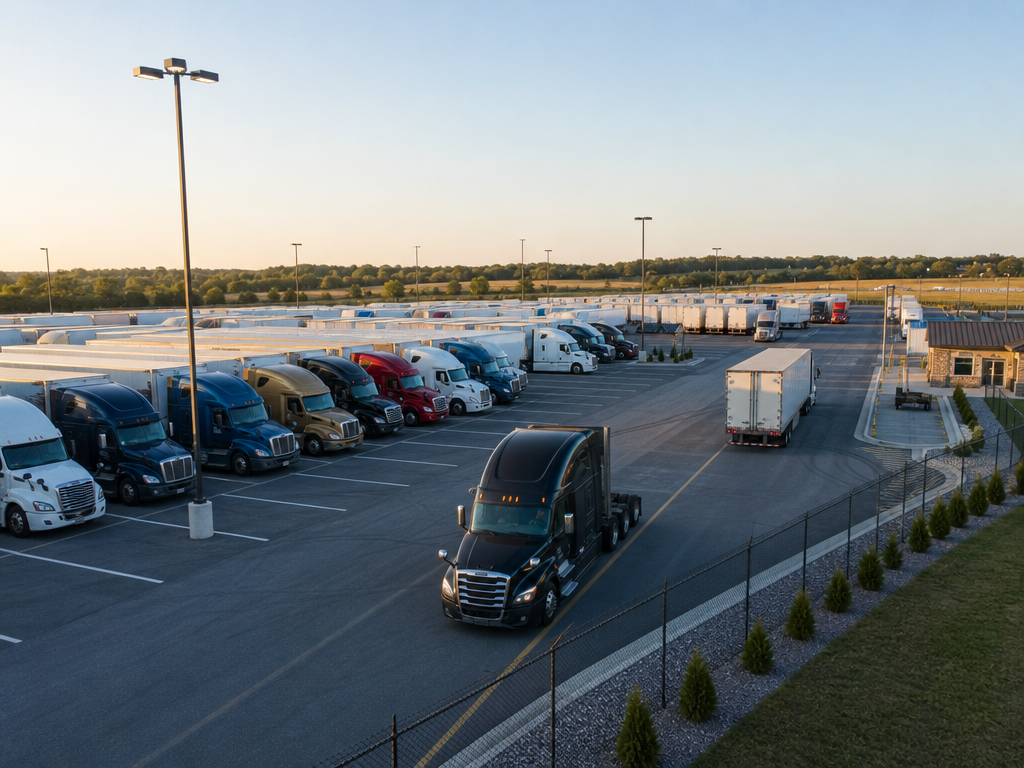
Imagine a 100-space truck parking lot. Ninety spaces are legitimately occupied. Five additional spaces contain unauthorized trucks. The operator technically has ten spaces remaining, but only five can actually be sold.
Now imagine that several drivers have already reserved those remaining spaces. When one arrives, the operator may have no usable inventory left despite having accepted and potentially collected payment for the reservation.
That changes enforcement from a simple compliance issue into an operational one.
ParqEx’s current truck parking platform makes this point directly: an unauthorized vehicle occupying a stall represents inventory the operator cannot sell.
Effective enforcement helps protect that inventory.
Reservations Give Enforcement a Starting Point
Enforcement becomes considerably easier when the parking operation already knows who is supposed to be there.
A truck parking reservation can establish:
- Driver information
- Vehicle information
- Arrival time
- Parking location
- Payment status
- Authorized parking period
- Reservation expiration
That creates a baseline.
If an enforcement officer encounters a truck at 10 p.m., the first question doesn’t have to be: “Does this truck look like it belongs here?”
Instead, it becomes: “Does this vehicle have an active authorization to park here?”
That’s a much more reliable basis for enforcement.
Access Control Can Prevent Some Violations Before They Happen
The most efficient parking violation may be the one that never occurs.
At controlled facilities, access management can prevent unauthorized vehicles from entering designated truck parking areas in the first place.
A paid reservation can be connected with authorization to enter the property. Depending on the property’s configuration, access may use mobile credentials, QR workflows, LPR, or compatible gate hardware.
When the authorized period ends, access can expire with it.
That creates an important relationship between access and enforcement.
Access controls who should get in. Enforcement addresses exceptions once vehicles are on the property. Neither completely replaces the other.
A driver could enter legitimately and then overstay. A gate may be open during certain periods. A vehicle could occupy the wrong area after entering.
But preventing unauthorized access at the beginning can reduce the number of problems enforcement teams need to resolve later.
LPR Makes Vehicle Verification Faster
Truck parking facilities can be large. Walking from truck to truck and manually checking permits or records isn’t always practical, especially at properties managing hundreds of commercial vehicles.
License plate recognition can help automate vehicle identification.
When LPR information connects with truck parking management software, a captured plate can be compared with current parking authorization.
ParqEx’s truck parking platform currently uses LPR as part of its vehicle-verification and access workflows, while the Enforcer platform can search registered vehicles by information including license plate, parking spot, and reservation number.
That allows personnel to spend less time figuring out which vehicle they’re looking at and more time dealing with genuine exceptions.

Overstays Are Different From Unauthorized Entry
Not every violation begins with someone entering illegally. A driver may have had a completely valid reservation. The problem begins when that authorization ends.
For example, a driver reserves a space until 6 a.m. Another driver has reserved the same inventory beginning later that morning.
If the first truck remains parked beyond its permitted time, the operator has a turnover problem. That’s why reservation expiration and enforcement need to communicate with one another.
ParqEx’s current truck parking workflow includes reminders before a reservation expires and allows eligible extensions when property rules and remaining inventory permit them. If the vehicle remains beyond its authorization, that exception can then move into the property’s enforcement workflow.
This creates an important distinction:
An extension is a parking transaction. An unapproved overstay is an enforcement issue.
Giving drivers an opportunity to legitimately extend when capacity allows can prevent unnecessary violations while creating additional paid parking time for the operator.
But when another reservation needs that inventory, enforcement protects the next driver’s right to use it.
Truck Parking Enforcement Doesn’t Have to Start With Towing
This is where modern enforcement can differ substantially from the traditional model.
A violation doesn’t necessarily mean the first action should be towing a commercial truck. In fact, ParqEx’s truck parking platform describes its Enforcer workflow as:
Detect → Verify → Document → Notify → Warn or Fee → Escalate → Tow, where appropriate.
The exact response depends on the property, the violation, and applicable requirements.
A facility might choose a different response for a driver who accidentally exceeded a reservation by several minutes than for a repeatedly unauthorized vehicle occupying paid inventory.
That’s the advantage of configurable enforcement.
Instead of every violation automatically producing the most severe response, operators can establish a process that reflects their actual parking policies.
Verification Before Enforcement Matters
This is especially important because incorrect enforcement creates its own problems.
Imagine towing or ticketing a driver who actually has a valid reservation. Now the operator hasn’t protected the customer experience; it has damaged it.
Digital parking records give personnel an opportunity to verify a vehicle before escalating the situation. ParqEx’s Enforcer platform is specifically designed around checking vehicles against parking records and reservations before personnel document and act on violations.
That verification step can help reduce enforcement mistakes while creating a clearer record of why action was taken.
Documenting Truck Parking Violations
When enforcement action is necessary, documentation matters.
A useful violation record may include:
- Vehicle information
- License plate
- Parking location
- Reservation status
- Violation type
- Date and time
- Photographic evidence
- Action taken
Digital documentation creates a record that can be referenced later rather than relying entirely on an employee’s recollection or handwritten notes.
ParqEx’s Enforcer app allows personnel to log violations and capture vehicle and license-plate photographs as part of the enforcement process. That information can also help operators identify patterns.
If the same violation repeatedly occurs in the same area, the problem may not simply be individual drivers. Signage, access configuration, parking layout, or operating rules may need attention.
Enforcement data can therefore improve the parking operation itself.
Consistency Matters Across Multiple Properties
Enforcement becomes harder when every location operates differently.
One property warns unauthorized vehicles. Another immediately escalates. Another relies on an employee who knows most drivers personally.
That inconsistency becomes especially difficult for organizations managing multiple truck parking facilities.
A centralized enforcement workflow allows operators to establish clearer rules across their portfolio while still accommodating property-specific requirements.
Personnel can work from the same types of parking records, authorization information, violation categories, and documentation processes.
ParqEx’s Enforcer platform supports enforcement across multiple properties from the same system.
That makes enforcement more scalable as a truck parking operation grows.
Enforcement Protects Parking Revenue
Truck parking enforcement also has a direct financial role.
Consider a facility charging for overnight parking. Every space occupied without authorization can represent a space that isn’t available to a paying driver. Over time, that adds up.
Unauthorized parking can reduce:
- Sellable inventory
- Reservation availability
- Parking turnover
- Utilization accuracy
- Potential revenue
Enforcement therefore supports the same principle we’ve discussed in Parking Space Revenue.
Parking is an asset. If an operator wants that asset to generate reliable revenue, it needs control over who uses it and under what conditions. A reservation establishes the transaction. Access helps protect entry. Enforcement helps protect the inventory after entry.
Enforcement Also Protects the Driver Experience
Revenue isn’t the only thing at stake. A reservation system depends on trust.
If drivers repeatedly reserve parking only to arrive and discover that their spaces have been occupied by unauthorized vehicles, the value of reserving begins to disappear.
A reservation should mean something. That means operators need a way to keep designated inventory available for legitimate users. Effective enforcement supports that promise.
It also helps maintain clear drive aisles, restricted areas, entrances, exits, and other portions of the property that shouldn’t become improvised parking simply because designated spaces are full.
Enforcement Should Be Part of the Parking Operation
The biggest mistake may be treating enforcement as a completely separate function.
Modern truck parking solutions can connect enforcement with the systems already managing the property.
Think about the full parking lifecycle:
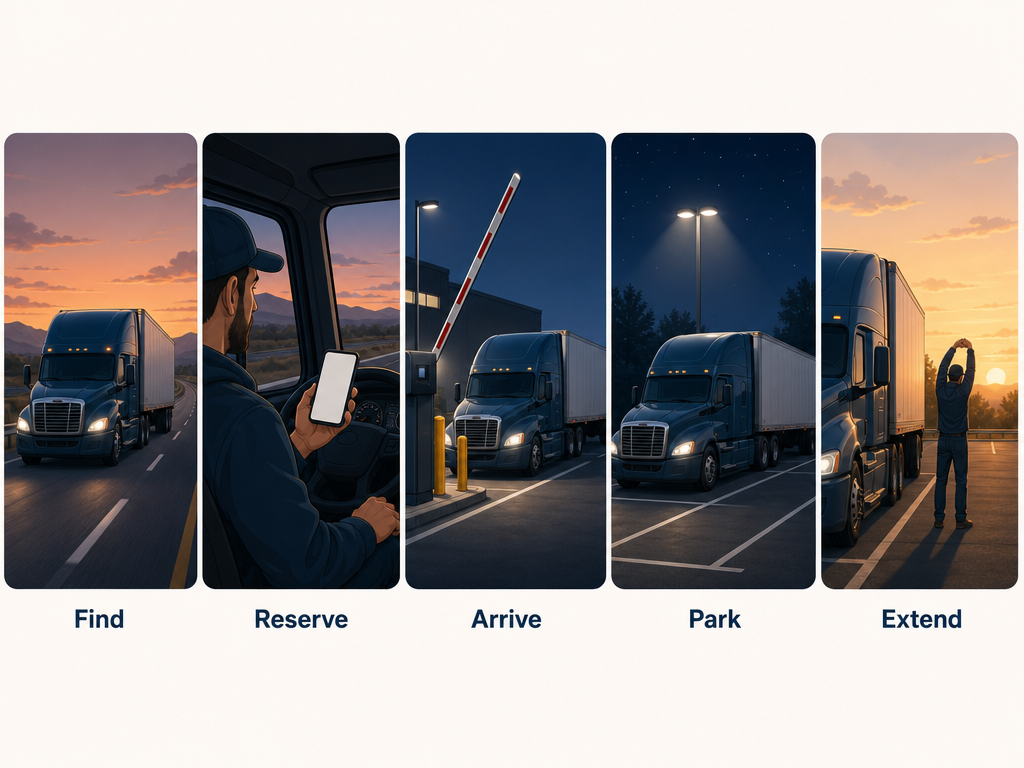
Reserve → Pay → Authorize → Enter → Verify → Park → Remind → Extend or Exit
Enforcement becomes relevant when something deviates from that expected sequence.
No reservation? Verify the vehicle.
No authorization? Follow the property’s enforcement process.
Reservation expired? Determine whether an extension is available.
Vehicle remains anyway? Document and escalate according to policy.
Wrong parking area? Verify the driver’s actual permission before acting.
This makes enforcement less reactive.
Personnel aren’t simply patrolling a lot hoping to spot something wrong. They’re responding to exceptions within a managed parking system.
Technology Doesn’t Decide the Parking Policy
Software can identify parking status and support workflows. It doesn’t eliminate the need for operators to establish clear rules.
Properties still need to decide:
- Who can park
- Where they can park
- How long they can stay
- Whether grace periods exist
- When extensions are permitted
- What constitutes a violation
- What response each violation warrants
- When escalation is appropriate
Those decisions may also depend on property configuration and local requirements. ParqEx explicitly notes that enforcement options depend on the property’s setup and applicable legal requirements.
Technology helps apply the resulting policy more consistently. That’s an important difference.
Parking policy defines what’s allowed. Enforcement makes that policy operational.
From Reactive Enforcement to Managed Compliance
Truck parking enforcement shouldn’t begin with a tow truck. It should begin with knowing what’s happening on the property.
Who reserved? Who paid? Which vehicle was authorized? When did that authorization begin? When does it end? Is an extension permitted? Has a violation actually occurred?
When reservations, payments, access, LPR, and enforcement work from connected parking information, operators can answer those questions much more quickly.
ParqEx’s truck parking platform connects reservations and payments with access control, LPR, enforcement, and reporting, so enforcement becomes part of the larger parking operation rather than an isolated response after something goes wrong.
The goal isn’t simply stricter enforcement.
It’s more informed enforcement, protecting legitimate drivers, available inventory, property operations, and the revenue those parking spaces can generate.