




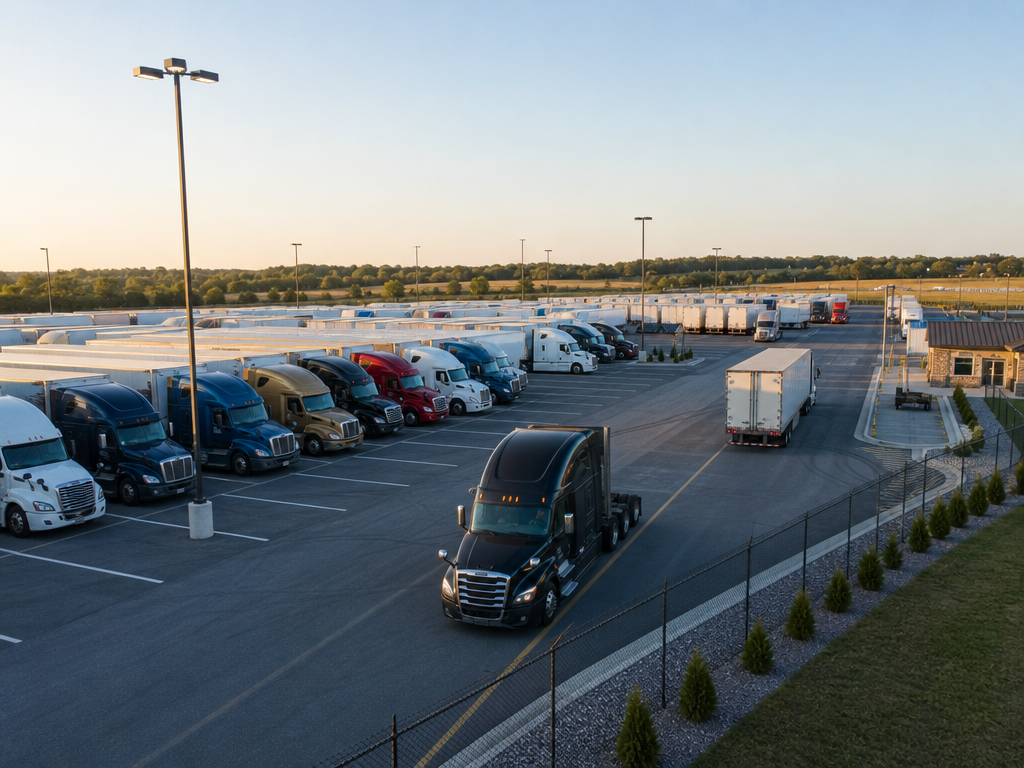
Not every revenue opportunity requires a new building, a major renovation, or a completely different business model. Sometimes, the opportunity is already sitting in the parking lot.
Consider an industrial property with several acres of unused pavement, a warehouse with truck parking spaces that sit empty after business hours, or an existing commercial parking facility that isn’t generating as much income as it could. For property owners, that unused space could represent an opportunity to bring in additional revenue without starting from scratch.
Of course, monetizing a truck parking lot involves more than putting up a sign and charging drivers to park. Property owners need to understand local demand, determine what their space can accommodate, establish competitive pricing, and figure out how to manage reservations and payments. There are also the everyday realities of accommodating commercial trucks, from maintaining suitable parking surfaces to ensuring drivers can safely enter and exit the property.
With the right location, a practical business model, and technology to simplify parking operations, however, turning available space into a revenue stream may be more achievable than many property owners realize.
Why Truck Parking Is Worth a Closer Look
Commercial truck drivers need places to park for a variety of reasons, whether they’re stopping overnight, waiting for a delivery appointment, taking a required rest break, or spending time between assignments. Depending on their routes and destinations, finding suitable parking isn’t always easy, particularly when drivers need a location that can accommodate large vehicles.
For property owners with available space near freight corridors, industrial districts, or distribution centers, this creates an opportunity worth exploring. A warehouse might have parking capacity available outside normal operating hours, while an industrial property could have enough room for several commercial vehicles without interfering with its primary business. Existing truck parking operators may have a different opportunity altogether: improving how their current spaces are advertised, reserved, and managed to generate more consistent revenue.
Although the circumstances vary from property to property, the underlying idea remains the same. Parking spaces that aren’t being used may have the potential to generate income, provided there’s sufficient demand and the property can support commercial vehicle parking.
The challenge is determining whether the opportunity makes financial sense and how to manage it without creating unnecessary operational work. ParqEx’s Truck Parking Solutions explores how parking technology can help commercial property owners make better use of available parking inventory.
Can You Actually Make Money From a Truck Parking Lot?
Truck parking can generate revenue, but the amount a property earns depends on much more than the number of vehicles it can accommodate. Location, pricing, occupancy, parking duration, and operating expenses all influence whether a facility becomes a worthwhile investment.
A lot near a major interstate or distribution center may attract drivers who need convenient overnight parking, while a property in an industrial district might be better suited for monthly customers or local fleets. These customers have different needs, and understanding those differences can help property owners decide which parking arrangements are most appropriate.
Pricing also plays an important role, although charging more doesn’t necessarily translate into greater revenue. A facility with competitive rates and consistent occupancy may perform better than one with higher prices and a large number of empty spaces. At the same time, property owners need to account for maintenance, insurance, utilities, payment processing, and other expenses that affect profitability.
Rather than focusing exclusively on how many trucks can fit on a property, it’s more useful to consider how much revenue those spaces could consistently generate and what it would cost to operate them. A smaller facility with steady demand and manageable expenses may offer a better opportunity than a larger lot that struggles to attract customers.
First, Make Sure Your Property Makes Sense for Truck Parking
Before estimating potential revenue, property owners should evaluate whether their space is actually suitable for commercial truck parking. An empty lot may look like an easy opportunity, but accommodating tractor-trailers requires considerably more planning than renting spaces to passenger vehicles.
Commercial trucks need adequate room to maneuver, park, and safely enter and exit a property. An area that appears spacious from the road may accommodate fewer vehicles than expected once turning requirements and drive aisles are considered. Entrances also need to be evaluated for width, clearance, and accessibility from surrounding roads, particularly if drivers will be arriving in full-size tractor-trailers.
The parking surface is another important consideration. Heavy commercial vehicles place significant demands on pavement and underlying ground conditions, so owners should determine whether existing asphalt, concrete, or gravel can support the intended traffic. Properties that weren’t designed for regular truck parking may require improvements to pavement, drainage, or access before they can accommodate paying customers.
Zoning, permits, and insurance should also be reviewed early in the process. Some properties may already permit commercial truck parking, while others may face restrictions on overnight parking, vehicle storage, or paid parking operations. Lease agreements and local regulations can introduce additional requirements, making it important to confirm what is allowed before investing in improvements or accepting reservations.
Not every unused lot should become a truck parking facility, and that’s perfectly fine. The best opportunities are properties where commercial parking makes sense from a physical, operational, legal, and financial standpoint.
Understand Who Would Actually Park There
Once a property appears suitable, the next step is understanding whether drivers would actually want to park there. Truck parking demand varies by location, and the needs of drivers traveling through an area may be very different from those of local trucking companies.
A facility near a busy highway might appeal to long-haul drivers looking for overnight parking, while a property near distribution centers could attract drivers waiting for scheduled appointments. Industrial areas may have demand from owner-operators who need a reliable place to park between assignments, particularly if their vehicles cannot be stored at home or at a company’s primary facility.
Researching nearby parking options can help property owners understand which customers they might be able to serve. It’s worth looking at what competing facilities charge, which parking durations they offer, and how convenient their locations are to major trucking routes. Conversations with local carriers, dispatchers, and logistics businesses may also reveal needs that aren’t immediately obvious through online research.
Sometimes the opportunity isn’t a complete lack of truck parking, but a shortage of a particular type of parking. An area might have several truck stops serving overnight customers but relatively few options for monthly parking. Understanding those gaps can help property owners develop a business model that meets actual demand rather than assuming every available space will attract paying drivers.
Different Ways to Monetize Truck Parking
One advantage of truck parking is that property owners aren’t limited to a single pricing or rental model. Depending on the location and customer base, facilities can offer overnight, daily, weekly, or monthly parking, and some properties may benefit from combining several options.
Overnight and Daily Parking
Overnight parking can be particularly useful near highways, freight corridors, and distribution centers, where drivers need convenient places to stop during their routes. Operators can rent available spaces on a nightly basis, giving drivers flexibility while creating opportunities to generate revenue from short-term demand.
Daily parking serves a similar purpose for drivers who need somewhere to leave a truck for an extended stop, a delivery delay, or a temporary parking arrangement. Both models benefit from making availability easy to check and reservations simple to complete, especially when customers are traveling through unfamiliar areas.
Weekly and Monthly Parking
Longer-term parking arrangements can appeal to property owners looking for more predictable income. Local owner-operators may need regular parking between assignments, while smaller trucking companies might require several spaces for their vehicles.
Monthly agreements can reduce the need to sell the same spaces repeatedly, although customers may expect a lower effective daily rate in exchange for a longer commitment. For some properties, the stability of recurring revenue may outweigh the potential to earn higher rates from individual overnight bookings.
Fleet Parking Agreements
Fleet customers represent another potential revenue opportunity, particularly for facilities near industrial and logistics hubs. A trucking company may need multiple spaces, consistent access, or a dependable location where vehicles can be parked between assignments.
These arrangements can provide a more stable customer relationship, but operators should evaluate whether the agreed rates make financial sense compared with other parking options. A discounted fleet agreement may be attractive when it fills spaces that would otherwise remain empty, while the same agreement could be less beneficial at a facility with strong overnight demand.
Combining Different Parking Options
Some facilities may find that a combination of parking models works best. A property could dedicate a portion of its inventory to monthly customers while offering remaining spaces for overnight reservations, or make parking available during hours when its primary business isn’t using the lot.
The important part is maintaining accurate availability and ensuring that different parking arrangements don’t conflict. When operators understand how their spaces are being used, they can make more informed decisions about which customers and pricing models offer the best opportunity.
How Much Revenue Could a Truck Parking Lot Generate?
For most property owners, the biggest question is how much income their available parking space could realistically produce. While actual earnings depend on local demand and operating conditions, a basic revenue calculation can provide a useful starting point.
Monthly Gross Parking Revenue = Available Spaces × Average Daily Rate × Days × Paid Occupancy Rate
For example, imagine a property with 20 truck-compatible parking spaces. If the owner charges an average of $25 per night and expects 60% paid occupancy over a 30-day month, the estimated revenue would look like this:
| Revenue factor | Example |
| Available spaces | 20 |
| Average nightly rate | $25 |
| Days per month | 30 |
| Paid occupancy | 60% |
| Monthly gross revenue | $9,000 |
| Annual gross revenue | $108,000 |
Under those assumptions, the property could generate approximately $108,000 in annual gross parking revenue. These figures are hypothetical rather than a forecast, and they don’t account for operating expenses, but they demonstrate how even a relatively small number of spaces could contribute to a property’s income.
Occupancy is particularly important because the number of available spaces and the parking rate don’t tell the entire story. Using the same 20-space facility at $25 per night, monthly gross revenue would change considerably depending on how often those spaces are rented.
| Paid occupancy | Monthly gross revenue |
| 30% | $4,500 |
| 50% | $7,500 |
| 70% | $10,500 |
| 90% | $13,500 |
In this example, the property hasn’t added any parking spaces or increased its rates. The difference comes entirely from how consistently the available inventory is being used, which is why improving parking utilization can be just as valuable as expanding a facility.
Estimate Your Own Parking Revenue
For property owners interested in exploring their own numbers, ParqEx offers a Parking Revenue Guide & Calculator to help evaluate potential income from available parking space.
It’s a useful starting point for understanding the relationship between parking inventory and revenue, although truck parking operators should also consider vehicle-specific space requirements, local demand, and the costs associated with preparing and maintaining a commercial parking facility.
Setting the Right Price for Truck Parking
Once property owners understand local demand and have a general idea of their revenue potential, pricing becomes the next consideration. Finding the right rate requires balancing what customers are willing to pay with the income needed to make the operation worthwhile.
Location and convenience can influence pricing considerably. A facility near a major freight corridor may offer drivers valuable access to their routes, while a property with good lighting, controlled access, and a well-maintained layout may provide a more appealing parking experience than a basic open lot.
However, higher prices don’t automatically produce better results. If a facility charges significantly more than nearby alternatives and struggles to attract customers, the additional revenue per reservation may not compensate for the empty spaces. Pricing too low can create the opposite problem, particularly when demand is strong and customers would be willing to pay more for convenient parking.
Comparing nearby facilities is a useful starting point, but operators should also pay attention to their own booking patterns. If overnight spaces are consistently filling, there may be an opportunity to revisit pricing or adjust the amount of inventory reserved for monthly customers. If demand is weaker during certain periods, different rates or parking options might help attract additional bookings.
Ultimately, the goal is to establish pricing that reflects the property’s value while encouraging consistent, profitable use of the available spaces.
Make Your Truck Parking Easy to Find and Reserve
Even a well-located parking facility with competitive pricing can struggle to generate revenue if drivers don’t know it’s available. For property owners trying to monetize unused space, making parking inventory visible to potential customers is an important part of the process.
Traditionally, truck parking operators might rely on roadside signage, phone calls, or direct relationships with local trucking companies. Those approaches can still be useful, but they don’t always reach drivers who are planning their routes or looking for parking in an unfamiliar area.
Digital reservations provide another way to connect available spaces with customers. Instead of calling multiple facilities to ask about availability, drivers can search for parking, review property details, and reserve a space before arriving. For operators, this makes it easier to offer inventory without requiring someone to answer every inquiry or manually process each booking.
This is particularly helpful for facilities serving overnight customers or operating without full-time staff on-site. When reservations and payments can be completed digitally, parking becomes more convenient for drivers and easier for property owners to manage.
ParqEx’s Truck Parking Reservations article explores how digital booking helps connect drivers with available parking and supports a more organized reservation process.
Managing Paid Truck Parking Without Creating More Work
One concern property owners may have about offering paid truck parking is the additional responsibility that comes with it. Someone needs to collect payments, confirm reservations, manage access, and handle situations where vehicles remain parked longer than expected.
These tasks can become time-consuming when handled manually, particularly at facilities where drivers arrive throughout the day and night. A property manager who is already responsible for a warehouse or industrial facility may not have the time to answer parking inquiries or coordinate individual arrivals.
Digital parking management technology can simplify many of these responsibilities by connecting reservations, payments, access permissions, and parking records. Drivers can book and pay online, while operators can review current reservations and determine which vehicles are authorized to use the property.
At facilities with compatible access-control equipment, drivers may also be able to enter using reservation-based credentials or vehicle verification rather than waiting for someone to open a gate. This can make paid parking more practical to operate without requiring staff to manage every arrival.
Technology doesn’t eliminate the need for property maintenance, customer support, or parking oversight, but it can reduce the repetitive administrative work involved in running a commercial parking operation. ParqEx’s Truck Parking Management solutions are designed to help property owners manage these connected processes more efficiently.
Protecting the Revenue Your Parking Lot Generates
Once a property begins accepting paid reservations, maintaining control over available parking spaces becomes especially important. Customers expect the parking they’ve reserved to be available when they arrive, and unauthorized vehicles can interfere with an operator’s ability to deliver that experience.
Consider a driver who books an overnight space, completes payment, and arrives to find another truck occupying the parking area. The operator now has to resolve the situation, potentially relocate the customer, and address the unauthorized vehicle. If these problems happen regularly, they can affect customer satisfaction and reduce the amount of inventory available for paying drivers.
Access control and parking enforcement can help operators manage these situations more effectively. At gated facilities, reservation-based permissions can limit entry to authorized vehicles, while supported license plate recognition systems can assist with vehicle identification and verification. Digital parking records can also help personnel determine whether a vehicle has a valid reservation or has exceeded its permitted parking period.
Clear parking policies are just as important as the technology itself. Drivers should understand when they can arrive, how long they can stay, whether extensions are available, and what happens if they occupy a space without authorization.
We’ve explored these processes in greater detail through Truck Parking Enforcement and Truck Parking Access Control. From a revenue perspective, both serve an important purpose: helping operators keep paid parking inventory available for the customers who are authorized to use it.
Using Parking Data to Improve Revenue Over Time
Once a truck parking facility is operating, tracking performance can help property owners identify opportunities that aren’t immediately obvious from looking at the lot. A facility may appear busy, but occupancy alone doesn’t necessarily indicate how much revenue it’s generating or whether the available spaces are being used efficiently.
For example, a property might be nearly full of monthly customers paying discounted rates, while another facility with fewer occupied spaces generates more revenue through overnight bookings. Neither model is automatically better, but understanding the difference can help operators decide how to allocate their inventory.
Useful information includes average paid occupancy, revenue per available space, popular parking durations, booking patterns, and the number of spaces that remain unused during different periods. Reviewing these trends over time can reveal whether the property would benefit from adjusting prices, changing its mix of short-term and long-term parking, or improving visibility during slower periods.
A facility might discover that overnight demand is strongest during the workweek, while weekends are consistently quieter. Another property could find that monthly agreements occupy most of its spaces even when short-term demand is particularly strong.
These insights give operators a better foundation for making decisions rather than relying entirely on assumptions. In some cases, the most effective way to increase revenue may not involve adding parking spaces at all, but simply making better use of the inventory that already exists.
Remember That Revenue and Profit Aren’t the Same Thing
Projected parking revenue can look attractive, especially when a property already has unused space. However, gross revenue only tells part of the financial story, and owners need to understand what it will cost to establish and operate the facility.
Depending on the property, expenses may include pavement maintenance, lighting, insurance, utilities, snow removal, payment processing, access-control equipment, and general upkeep. Some facilities may also require significant upfront improvements to accommodate commercial trucks safely, while others may already have much of the necessary infrastructure in place.
These differences can have a substantial impact on profitability. A property generating $10,000 in monthly gross parking revenue may be an attractive investment if operating costs are relatively low, but the financial picture changes when substantial maintenance, staffing, or financing expenses are involved.
A basic operating profit calculation is:
Operating Profit = Parking Revenue − Operating Expenses
For a more complete investment analysis, owners should also consider startup costs, financing, taxes, depreciation, expected cash flow, and the opportunity cost of using the property for truck parking instead of another permitted purpose.
The objective isn’t simply to generate parking revenue. It’s to establish an operation that produces a worthwhile financial return after accounting for the resources required to run it.
Could Truck Parking Increase Commercial Property Value?
For commercial property owners, the potential benefits of paid parking may extend beyond the revenue generated each month. When an underutilized portion of a property begins producing consistent income, it can potentially improve the asset’s overall financial performance.
In certain circumstances, additional net operating income may contribute to commercial property value, particularly when the property is evaluated using an income-based valuation approach. However, that impact depends on several factors, including the stability of the parking revenue, operating expenses, property restrictions, and the long-term viability of the business.
A well-established parking operation with recurring customers and consistent occupancy may be viewed differently from a temporary arrangement with unpredictable demand. Buyers and appraisers may also consider whether the parking operation can continue under new ownership and whether the property has the necessary approvals to support that use.
For owners considering truck parking as a longer-term investment, this reinforces the importance of building a sustainable operation rather than focusing exclusively on short-term revenue.
How ParqEx Helps Property Owners Monetize Truck Parking
Turning available parking space into a revenue-producing operation involves several connected processes. Drivers need a way to discover the property, check availability, reserve spaces, complete payments, and access the facility, while operators need visibility into reservations, authorized vehicles, and overall parking performance.
Managing those responsibilities through phone calls, spreadsheets, and manual payment collection can quickly become difficult, particularly as the number of customers grows. ParqEx helps bring these processes together through its Truck Parking Platform, making it easier for property owners to manage paid parking without developing their own reservation and payment infrastructure.
Depending on the property’s setup and supported integrations, ParqEx can help operators with:
- Parking marketplace visibility: Helping drivers discover participating parking locations and available inventory.
- Digital reservations and payments: Giving customers a convenient way to reserve and pay for parking.
- Access control: Connecting parking authorization with compatible gates and entry systems.
- License plate recognition: Supporting vehicle identification and verification where configured.
- Parking enforcement: Helping operators identify unauthorized vehicles and manage parking violations.
- Reporting and analytics: Providing insight into parking activity, utilization, and revenue.
- Multi-property management: Supporting organizations that manage parking across multiple locations.
For property owners, the benefit is having a more connected way to manage the business side of parking. Rather than coordinating individual transactions and tracking reservations manually, operators can use technology to simplify everyday processes and gain a clearer understanding of how their facilities are performing.
The physical property, required approvals, and necessary infrastructure still matter, and technology doesn’t replace those responsibilities. What it can do is make it easier to manage paid parking as a business, whether the owner is offering a handful of available spaces or operating a larger commercial truck parking facility.
Frequently Asked Questions About Truck Parking Revenue
How much money can you make from a truck parking lot?
Revenue depends on the number of available spaces, pricing, occupancy, and operating costs. For example, a 20-space facility charging an average of $25 per night at 60% paid occupancy would generate approximately $9,000 in monthly gross revenue. Actual earnings will vary based on local demand and expenses, so property owners should use realistic assumptions when evaluating potential profitability.
Can I rent out unused industrial property for truck parking?
Industrial properties may be suitable for paid truck parking if they have adequate space, appropriate parking surfaces, safe vehicle access, and the necessary zoning and permissions. Before accepting customers, owners should review local requirements and confirm that commercial truck parking won’t interfere with existing property operations.
Is overnight or monthly truck parking more profitable?
Neither model is automatically more profitable, since the answer depends on customer demand, pricing, and occupancy. Overnight parking may generate higher revenue per occupied night, while monthly agreements can provide more predictable recurring income. Some facilities may benefit from combining both options to serve different customers.
Do I need employees on-site to operate a truck parking lot?
Not necessarily. Digital reservations, payments, and compatible access-control systems can reduce the need for staff to process individual arrivals, although properties still require maintenance, customer assistance, and appropriate oversight. The level of staffing needed will depend on the facility and its operating model.
How can I attract more customers to my truck parking lot?
Start by making sure the property meets a genuine parking need and is convenient for the drivers you’re trying to reach. Competitive pricing, accurate availability, clear property information, and an easy reservation process can all help attract customers. Offering spaces through a parking marketplace may also improve visibility among drivers looking for commercial truck parking.
How can I estimate my truck parking revenue?
Begin by calculating the number of usable spaces, expected parking rates, and realistic occupancy levels, then account for operating expenses and any necessary property improvements. The ParqEx Parking Revenue Guide & Calculator can help property owners explore the potential revenue opportunity before developing a more detailed financial model.
Your Next Revenue Opportunity Might Already Be Sitting Empty
Not every commercial property has the location, infrastructure, or available space to support paid truck parking. For those that do, however, unused parking capacity could represent an opportunity to generate additional income from an existing asset.
The most important step is approaching the opportunity with a realistic plan. Property owners need to understand local demand, determine what their space can accommodate, establish pricing that makes financial sense, and account for the expenses involved in operating a commercial parking facility. From there, making parking easy to discover, reserve, and pay for can help turn available spaces into a more consistent revenue stream.
Technology can make that process easier by connecting reservations, payments, access control, and reporting into a more manageable operation. Instead of spending time coordinating individual parking transactions, property owners can focus on understanding demand, improving utilization, and making better decisions about their available inventory.
Whether you’re considering paid truck parking for the first time or looking to improve an existing facility, understanding the potential revenue is a useful place to begin. Explore the ParqEx Parking Revenue Guide & Calculator to evaluate what your parking space could generate, or learn more about the technology behind ParqEx Truck Parking.
Sometimes, increasing property revenue doesn’t require finding more space. It simply means making better use of the space you already have.