



Parking Management Software Isn’t an Expense. It’s an Operational Investment.
When people think about parking management software, the first question is often:
“How much does it cost?”
A better question might be:
“How much is manual parking management already costing us?”
For many properties, parking is still managed through spreadsheets, paper permits, emails, phone calls, manual enforcement, and staff intervention. While those processes may seem inexpensive on the surface, they quietly consume valuable time, reduce operational efficiency, and leave revenue opportunities untapped.
The best parking management software isn’t simply about digitizing permits or enforcing parking policies.
It’s about reducing administrative labor, improving parking utilization, increasing revenue, and delivering a better experience for residents, guests, and staff.
The real return on investment comes from transforming parking from an operational headache into a strategic business asset.
Where Properties Lose Money Without Realizing It
Many parking-related costs never appear as a line item on a financial statement.
Instead, they show up as:
- Staff spending hours each week answering parking emails
- Residents calling to report unauthorized vehicles
- Guest parking complaints
- Underutilized parking inventory
- Missed parking revenue opportunities
- Manual reporting and administrative work
Individually, these issues may seem minor.
Collectively, they can represent tens of thousands of dollars in hidden operational costs every year.
Parking Management Is Becoming Community Management
Parking no longer operates in isolation.
Today’s residents expect seamless digital experiences—from guest registration and package delivery to amenity reservations and parking.
Modern communities are increasingly connecting parking with broader resident experiences, visitor management, and operational workflows.
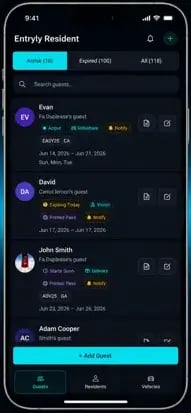
Solutions like Entryly Community Management reflect this evolution by bringing together parking, visitor access, resident communication, and community operations into a single ecosystem.
For property teams, that means fewer disconnected systems, less manual work, and a more connected resident experience.
This evolution reflects the broader shift toward Parking as a Service, where parking is managed as a dynamic operational asset rather than a fixed amenity.
Example: The Hidden Cost of Manual Parking Management
Consider a multifamily community with:
- 200 parking spaces
- One property manager
- Two leasing staff members
Each week, the management team spends approximately:
- 4 hours managing permits
- 2 hours responding to parking complaints
- 2 hours coordinating guest parking
- 2 hours handling enforcement questions
That’s roughly 10 hours every week dedicated to parking administration.
Assuming a fully loaded labor cost of $35 per hour, that’s approximately:
- $350 every week
- $1,500 every month
- More than $18,000 every year
And that’s before accounting for resident dissatisfaction, missed leasing opportunities, or unrealized parking revenue.
ROI Starts With Labor Savings
One of the fastest returns comes from reducing administrative work.
Modern parking management software automates tasks such as:
- Digital permit management
- Guest parking registration
- Resident self-service
- Parking policy enforcement
- Reporting and analytics
Instead of spending valuable staff time answering repetitive parking questions, teams can focus on leasing, resident satisfaction, and higher-value operational priorities.
Better Utilization Creates More Revenue
Many properties assume their parking is full.
Sold-out parking isn’t always optimized parking.
The data often tells a different story.
Reserved spaces sit empty.
Guest spaces become long-term storage.
Monthly permits are underpriced.
Entire sections of parking remain underutilized during certain times of day.
This is where Parking Utilization Optimization becomes one of the biggest drivers of return on investment.
In many cases, improving utilization creates significantly more value than building additional parking.
Parking Data Leads to Better Decisions
The most successful parking operations are no longer based on assumptions.
They’re based on data.
Modern parking management platforms provide visibility into:
- Occupancy trends
- Demand patterns
- Permit activity
- Guest parking usage
- Revenue opportunities
Instead of reacting to parking problems, operators can make proactive decisions that improve operations over time.
As predictive technologies continue to evolve, AI Parking Demand Forecasting allows organizations to anticipate future demand, optimize pricing, allocate parking more effectively, and plan staffing before problems occur.
Instead of asking:
“How full is our parking today?”
Forward-thinking operators are beginning to ask:
“How full will it be next Friday?”
That shift—from reactive parking management to predictive parking operations—is where the industry is heading.
Fewer Complaints Create Better Resident Experiences
Parking complaints consume more staff time than many operators realize.
Unauthorized vehicles.
Guest parking disputes.
Permit questions.
Availability concerns.
Each issue requires employee attention.
Digital parking management reduces these repetitive issues through clearer policies, automated workflows, and better communication.
The result is:
- Fewer complaints
- Happier residents
- Less administrative work
- More consistent parking operations
Revenue Opportunities Extend Beyond Monthly Permits
For many organizations, parking represents one of the few existing assets capable of generating new revenue without expanding the property itself.
Modern parking management software helps unlock opportunities such as:
- Dynamic parking pricing
- Marketplace parking
- Guest parking monetization
- Event parking
- Premium reserved parking
- Shared parking programs
Many operators discover they can generate significantly more revenue from existing parking inventory without constructing a single new parking space.
Scenario Simulation: What ROI Can a Typical Property Expect?
Consider a 200-space apartment community that currently manages parking manually.
Each week, the onsite team spends roughly 10 hours handling permits, guest parking requests, resident complaints, enforcement questions, and reporting.
At an estimated labor cost of $35 per hour, that’s more than $18,000 annually spent on parking administration.
After implementing modern parking management software, much of that work becomes automated or resident self-service.
Potential Annual Impact
Labor Savings
- Approximately 500 administrative hours eliminated
- Roughly $18,000 in recovered staff time
Better Parking Utilization
Now imagine the property identifies 20 parking spaces that frequently sit empty during evenings and weekends.
Instead of leaving those spaces unused, management opens them to transient renters through a parking marketplace.
Assuming:
- 20 available spaces
- Average rental rate of $8 per day
- Average occupancy of 70%
Those previously unused spaces could generate approximately:
$41,000 in additional annual parking revenue
without constructing a single new parking space.
Combined Impact
When labor savings and new parking revenue streams are considered together, the property could realize nearly:
$60,000 per year in measurable financial value.
Every property is different.
But the principle remains the same.
The greatest returns often come from optimizing the parking assets a property already owns.
The ROI Goes Beyond Dollars
Financial returns are only part of the story.
Properties implementing modern parking management software often experience:
- Improved staff productivity
- Better operational consistency
- Stronger parking compliance
- Better resident experiences
- More informed decision-making
- Greater scalability as communities grow
These operational improvements compound over time, creating long-term value well beyond direct revenue gains.
Final Takeaway
For years, parking has been treated as a cost center—something that simply needed to be managed.
Forward-thinking property owners are beginning to see it differently.
They’re treating parking as an operational asset capable of reducing labor, improving resident experiences, generating new revenue, and informing smarter business decisions.
That’s why the return on parking management software isn’t really about software at all.
It’s about transforming one of a property’s most overlooked assets into one of its most valuable operational advantages.